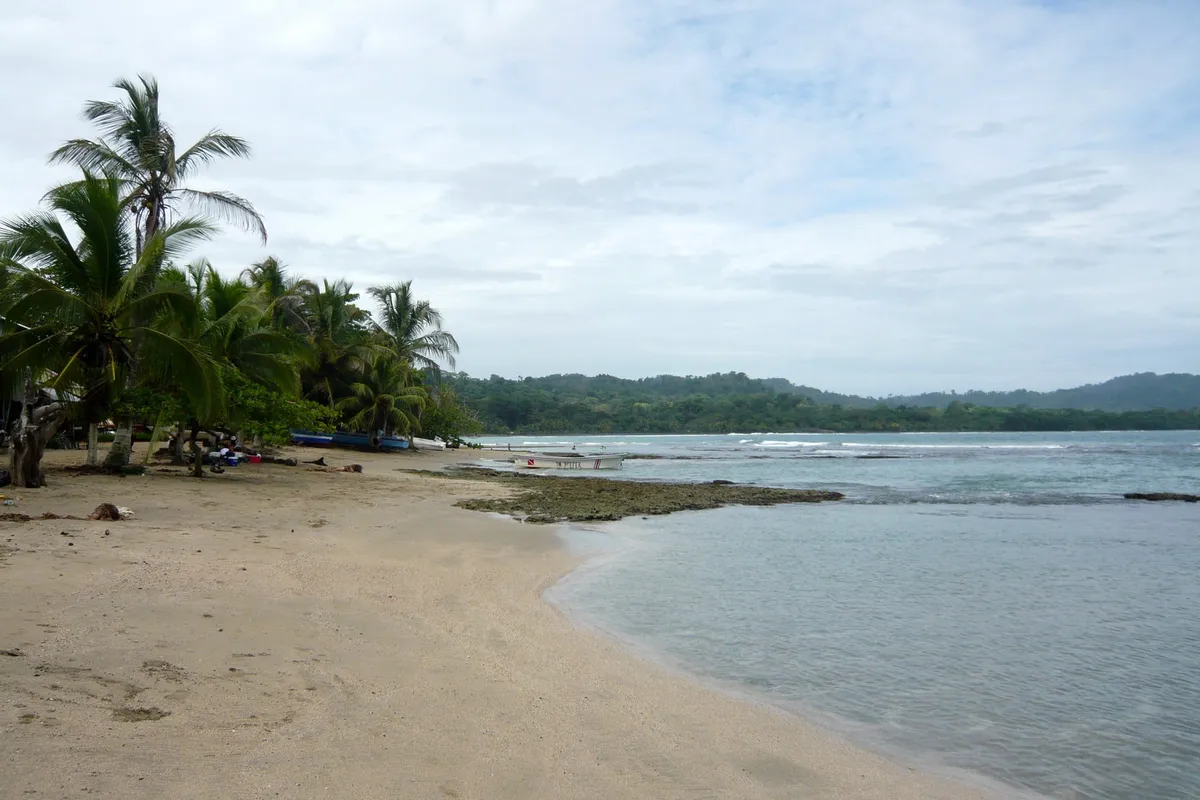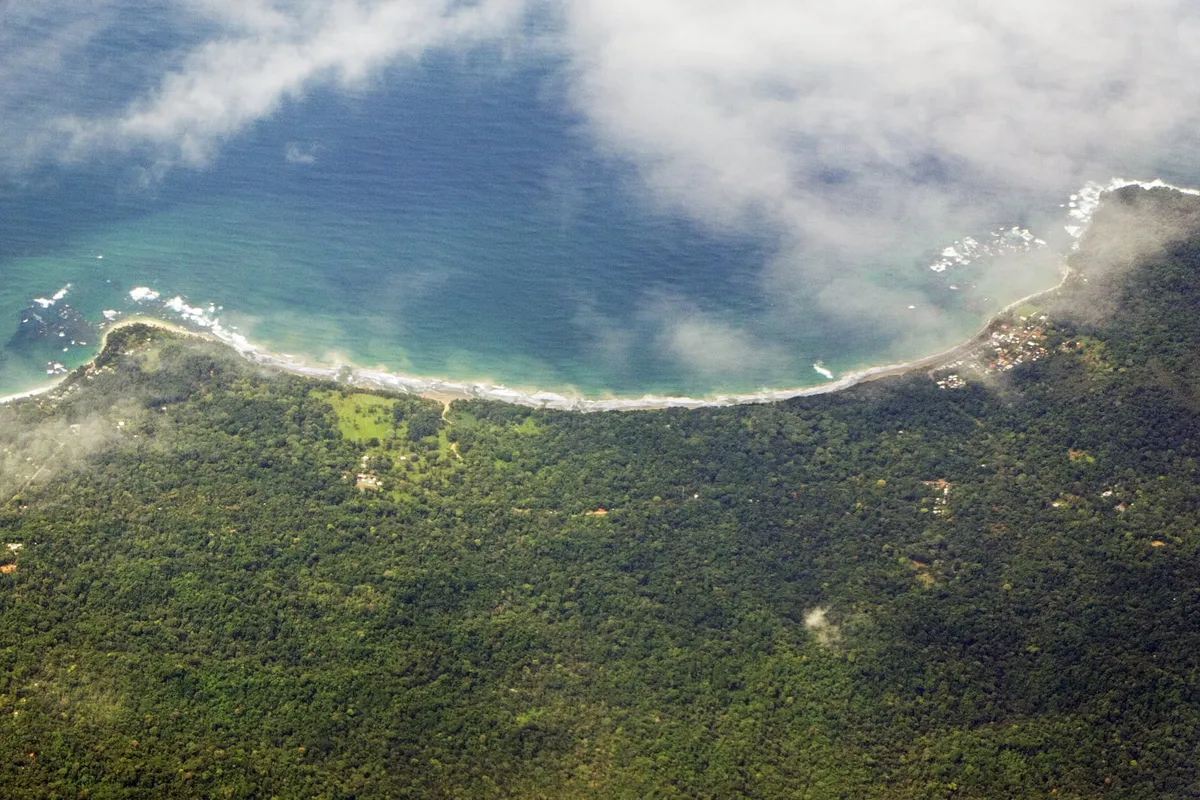
On 12 December 2019, the First Chamber of Costa Rica’s Supreme Court, the Sala Primera, annulled the parts of a 1996 decree that had taken a coastal strip of Cocles out of the Kéköldi indigenous territory. Land that hotels, houses and restaurants had stood on for decades was back inside the reserve’s legal boundary. Since 2021 the Registro Nacional has carried a note on the affected properties. On 27 April 2026, bill 25545 was filed to draw the boundary again. As of September 2026 it has not been voted on.
The dispute concerns where a legal line falls, and it does not reach all of Cocles. Whether a given lot is affected depends on its position against that line and on the history of its title, and both have to be checked lot by lot.
How the boundary moved
The line has been redrawn by decree several times. The bill’s own statement of reasons sets out the sequence. Decree 7267-G of August 1977 created the Cocles reserve, fixed its limits and had it registered as part of the Talamanca reserve. Ley Indígena 6172, passed on 29 November 1977, gave those decree boundaries the force of law and says, in its first article, that a reserve can only be reduced by an express law.
In 1985 a further decree made Cocles a reserve of its own. Decree 25296-G of 24 June 1996 renamed it Bribrí de Kéköldi and removed an area described as included by mistake, which covered private farms and part of the coast. A 2001 decree, 29956, added land in the northwest, between the sources of the Carbón rivers.
The 2019 ruling, 004507-F-S1-2019, struck down the 1996 exclusion but kept the changes that favoured the reserve. Its reasons included that the indigenous community had not been consulted, and that a reduction required a law, not a decree. According to La Nación, the land returned to the reserve came to about 1,200 hectares near Playa Cocles. In the case itself, the court found that the company involved had bought in good faith and ordered that its land be expropriated with compensation. That order applied to that company. It did not validate every other sale in the area or promise compensation to every owner, and whether the company has since been paid, and how much, could not be confirmed.
What the law says about land inside a reserve
Article 3 of the Ley Indígena makes reserves inalienable and reserved to the indigenous communities that live in them. People who are not indigenous may not buy, rent or otherwise acquire land inside one.
A registered title does not settle the question on its own. On 31 July 2024, in ruling 2024-004917, the Tribunal Contencioso Administrativo refused compensation to the heir of an owner of land inside Kéköldi. The two registered properties had been bought in 2002 and 2007, after the reserve existed, and the court held that reliance on the public registry did not save a purchase that article 3 forbids. That case concerned land that had been inside the reserve throughout. Whether the same reasoning reaches lots that were outside it from 1996 and came back in 2019 has not been decided, and it should not be assumed.
Two kinds of compensation
The debate uses “compensation” for two different things. One is indemnización: money paid to an owner whose land is expropriated, when the legal conditions are met. A court order to pay is not proof that payment happened. The other is territorial compensation: other land added to the reserve in exchange for land taken out. The bill’s supporters argue that the State already made that exchange decades ago with land from ITCO, the land agency now called INDER. The two claims answer different questions and should not be read as one.
What bill 25545 proposes
The Ley para la Delimitación Territorial de la Reserva Indígena Bribri de Këköldi (Cocles), expediente 25545, was filed by Carolina Delgado Ramírez of the Partido Liberación Nacional on 27 April 2026. Delfino’s legislative tracker lists it as presented, with its committee still to be assigned and no votes recorded.
The text is short. Article 1 sets new boundaries through a table of coordinates. Transitorio I makes INDER and the Comisión Nacional de Asuntos Indígenas (CONAI) responsible for funding and marking the new line on the ground. Transitorio II orders the Registro Nacional to lift, on its own initiative, the annotations placed on properties because of the 2019 ruling.
The statement of reasons puts the remaining territory at about 5,386 hectares. Delfino compares that with the current 7,857 hectares: a reduction of 2,471 hectares, or 31.5 per cent. Semanario Universidad reports that the excluded area includes parts of Playa Cocles and Playa Chiquita and runs inland toward the hills. The territory as a whole crosses three districts of Talamanca: Sixaola, Bratsi and Cahuita.
Three points in the text are unresolved. The statement of reasons says the bill must go through free, prior and informed consultation with the Kéköldi development association and the traditional authorities, but nothing shows that this has happened. It also says the operative part contains no reparation measures and leaves them to legislators. And Transitorio II, as written, does not limit the lifting of annotations to properties that fall outside the new perimeter, which leaves its relation to Article 1 unclear. That is a reading of the text, not a legal ruling.
Who holds which position
The groups involved do not divide into two neat sides. The Asociación de Desarrollo Integral del Territorio Indígena Kéköldi (ADITIK) has kept its cases going in the courts. In December 2023, the Sala Constitucional annulled the public hearing on the Cahuita coastal zoning plan, which covers the shore from Cahuita to Manzanillo, because the Kéköldi people had not been consulted.
On 26 November 2024, after a complaint from the association’s then president, Signia Villanueva Morales, it annulled a second hearing and repeated the order, Semanario Universidad reported. That dispute concerns the zoning plan, not the boundary.
In May 2026 the association’s vice president, Dulcelina Sánchez, spoke against the bill and said the territory reaches the sea: the community used the coast for cultural activities and left it unbuilt because it is wetland.
The Asociación de Vecinos Unidos por la Paz y la Justicia de Cocles says it speaks for 1,244 residents. Its president, Óscar Brown Colphon, backed the bill on 16 May 2026, arguing that private land was included in the reserve by error.
The Bloque de Cocles, a separate group of owners, organises legal help and funding. It reports a Sala Constitucional result concerning the Plaza de Cocles and trespass notices served on owners in Calle Tucán in 2025; neither claim has been checked against the original documents.
Bloque Verde, an environmental group unrelated to the Bloque de Cocles, opposes the bill and how its consultation is framed. Within the indigenous community, the Consejo de Mayores made complaints against ADITIK in June 2026 about how the association runs community affairs, Trece Noticias reported. The association’s president denied them, and the complaints say nothing about the boundary.
What it would mean for an owner
The bill’s stated aim is to let owners of the affected land keep it and have the registry annotations removed. That does not mean every owner would be protected, and it does not mean every owner would lose their land if it fails.
If the bill passes in its current form, the question for each lot becomes where it sits against the new coordinates. A lot that stays inside the territory remains under the indigenous regime. A lot that ends up outside still has to clear every other check: the title chain, the maritime zone (which the bill’s authors argue could never have been part of a reserve), environmental limits and permits. If the bill does not pass, the 2019 boundary stands, and so do the annotations.
Before an offer
- Pull the property’s record on RNPDigital and look for an annotation tied to resolution 004507-F-S1-2019.
- Have a surveyor place the plano catastrado against both the 1977 boundary restored in 2019 and the coordinates in bill 25545. The plano catastrado guide covers the other checks.
- Trace the title back to 1977 and note when each transfer was registered.
- Check the bill’s status in the Asamblea Legislativa’s records again shortly before signing.
This is general information, not legal advice. A Costa Rican attorney who has worked on Kéköldi cases can read a specific title against the rulings and the bill, and that opinion should come before any deposit is paid.
Sources
- Sala Primera, resolution 004507-F-S1-2019, 12 December 2019.
- Tribunal Contencioso Administrativo, ruling 2024-004917, 31 July 2024.
- Asamblea Legislativa, bill 25545, full text with map and coordinates, April 2026.
- Delfino, bill 25545 status, checked September 2026.
- Semanario Universidad, positions on the bill, 20 May 2026.