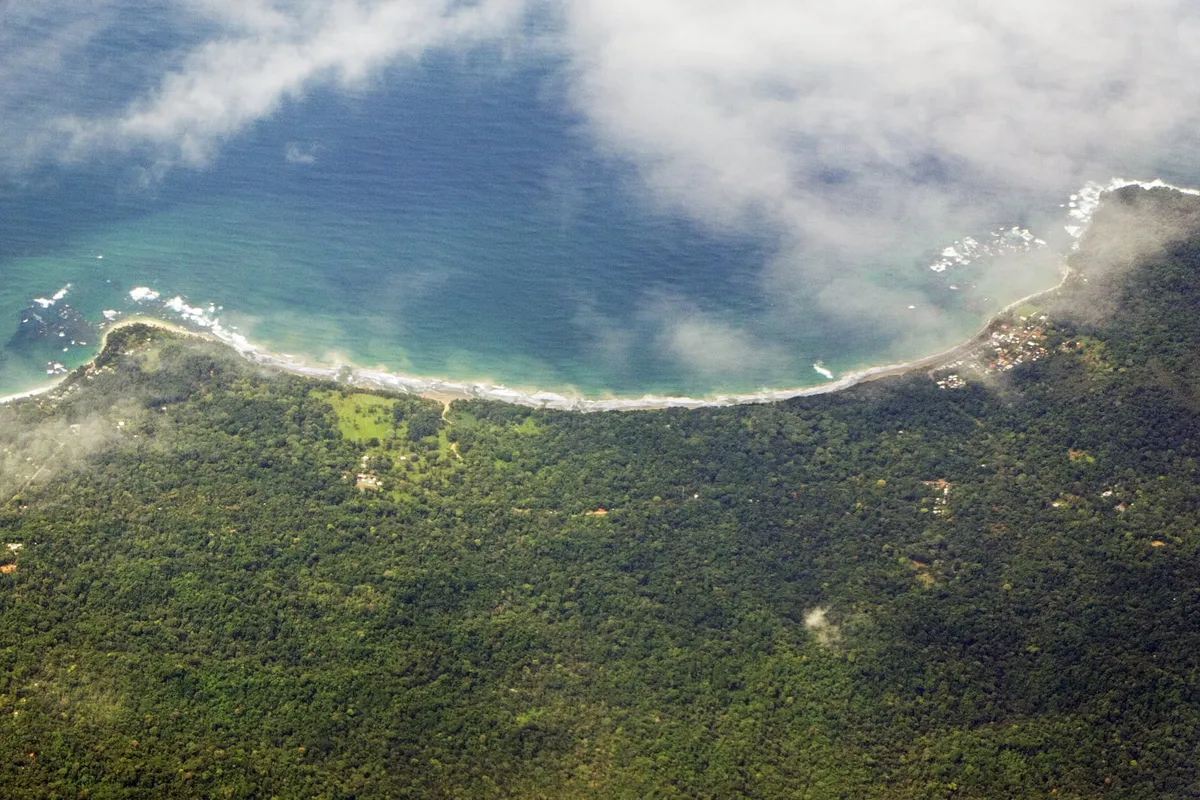
Costa Rica places no general restriction on foreign ownership of real estate. A foreign buyer can hold title to a house or a piece of land the same way a Costa Rican citizen does. There is one significant exception, and it matters directly on this coast: land within the maritime zone.
Titled land and the maritime zone
Costa Rican law (the Ley sobre la Zona Marítimo Terrestre) treats the 200 metres inland from the mean high-tide line as a special zone. The first 50 metres (the public zone) cannot be privately owned. The remaining 150 metres (the restricted zone) are usually owned by the municipality and made available through a concession rather than a title deed. Concessions carry conditions on who can hold them and how the land can be developed. They are administered by the local municipality, not the National Registry.
Land outside the 200-metre maritime zone is ordinary titled property (propiedad en fee simple), registered at the National Registry like any other real estate in the country. This is the more straightforward form of ownership, and most listings inland of the immediate beachfront on this coast are titled.
The south Caribbean coast, from Puerto Viejo to Manzanillo, has an added complication. Parts of the Talamanca canton have never been fully surveyed into the national cadastre, and boundaries between titled land, maritime zone and other protected areas are not always settled on paper. Parts of this coast also sit near protected areas such as the Gandoca-Manzanillo National Wildlife Refuge, which limits what can be built nearby. A property that looks straightforwardly titled can still have a boundary or zoning question behind it. This is the single most important thing to check before making an offer here, and it is not something to check alone.
Steps in a purchase
- Buyer and seller agree a price and terms in a written offer. A reservation deposit is usually held by a third party (an escrow agent or the buyer’s attorney) while due diligence is done.
- In due diligence, a Costa Rican attorney searches the title at the National Registry and checks for liens or mortgages. The attorney also confirms that the property is not inside the maritime zone’s public area. On this coast in particular, the check includes whether the surveyed boundaries (the plano catastrado) match what is being sold.
- Terms, price and closing date are set out in a purchase agreement, typically in Spanish and drafted or reviewed by the buyer’s own attorney.
- Real estate transfers in Costa Rica are executed by a notario público (an attorney with additional notarial authority). The notary drafts the transfer deed (escritura) and registers it at the National Registry. Buyer and seller do not need to use the same notary; a buyer is free to bring their own.
- The registered deed is the buyer’s proof of title. It can take the Registry some weeks to process.
Closing costs include registration fees, notarial fees and applicable taxes. The main amounts are set by law and decree: the transfer tax is 1.5 percent (Law 6999), and the notary’s fee has a legal minimum (Decree 41457-JP, article 74). Who pays which share is a matter of custom between buyer and seller, so the split and the total vary by transaction. The closing costs guide sets out the figures. An itemised estimate before signing shows both the total and the split.
Residency is not required to buy
A foreign buyer does not need Costa Rican residency to hold title to ordinary real estate. Residency matters more for anyone planning to live in the country for an extended period. It also matters for anyone hoping to hold a maritime-zone concession, which does carry residency-related conditions.
Costa Rica offers several residency categories that owners of a coastal house often look into: pensionado (a fixed pension income), rentista (a fixed unearned income) and inversionista (a qualifying investment). Each has its own requirements and its own application through immigration counsel, separate from the property purchase itself. Buying a house and living in it long-term are separate questions, each with its own paperwork.
A Costa Rican attorney experienced in local real estate should review any purchase on this coast before anything is signed.